Mustang Charging Problems? Check This Hidden Wiring on Your 1965–66 Mustang
Mustang charging problems can drive you crazy. If your 1965 or 1966 Mustang has a battery that keeps going dead, intermittent hard starts, flickering lights, or stalling that comes and goes, you’ve probably already thrown parts at it. A new alternator, a new voltage regulator, maybe a new battery. And the problem keeps coming back.
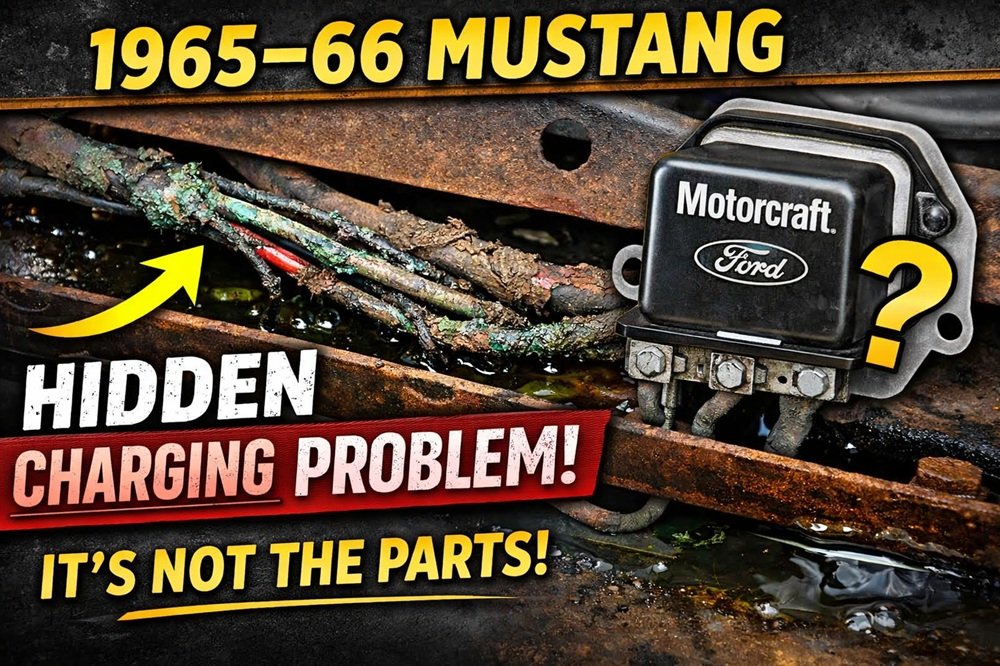
That’s exactly what happened with my car. It turned out my Mustang charging problems weren’t caused by a part at all. It was a section of factory wiring hidden where you’d never think to look.
Safety first: this guide is for reference only. Always follow proper safety procedures, consult a professional if you’re unsure, and never do any electrical work without disconnecting the battery first.
Where the Problem Hides
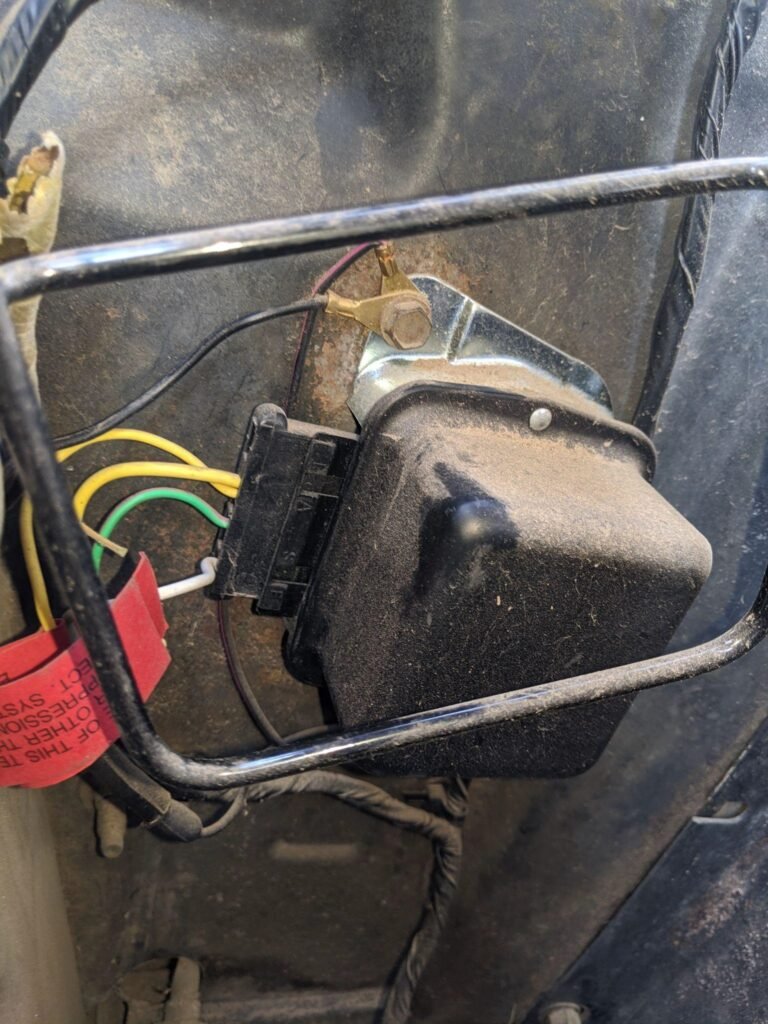
On 1965–66 Mustangs, the wires that run from the alternator and battery side, under the radiator support, and over to the voltage regulator on the driver side are factory installed. It’s a short run of three or four wires, and it’s completely out of sight, which is why it gets overlooked when people diagnose Mustang charging problems.
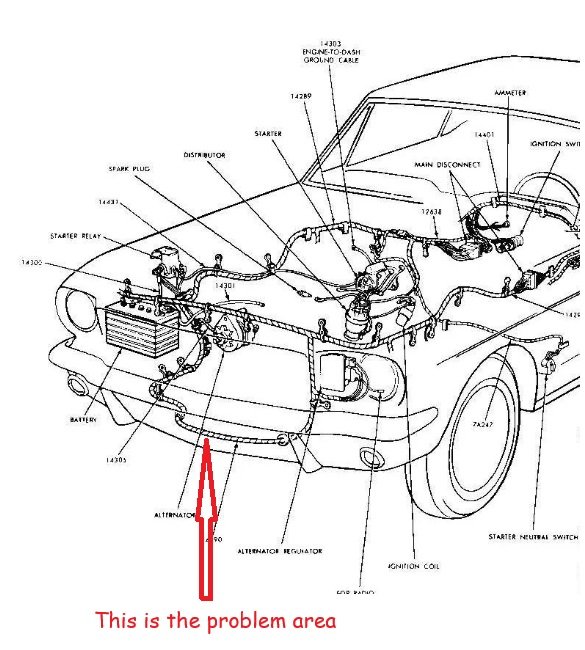
Diagram: Ford shop manual, with arrow added to show the harness route.
Why This Location Fails
The lower radiator support acts like a trough. Any coolant spilled during refills, minor overheating, or overflow from the radiator cap ends up right there. Add rain, road grime, salt, and years of heat cycling, and you’ve got the perfect environment for wiring to slowly rot from the inside.
Antifreeze is especially bad. It absorbs moisture, breaks down over time, and wicks into the wire insulation. The insulation can look fine on the outside while the copper inside turns black or green. That corrosion creates resistance, and the resistance changes with temperature.
Why Mustang Charging Problems Feel Random
This is why these cars feel haunted. As the corroded wiring heats up, resistance goes up. When it cools down, resistance drops again. So the car might die at a stoplight, restart after it cools off, run fine for weeks, and then suddenly act up again. That pattern makes it easy to blame the wrong part, and it’s why so many Mustang charging problems get “fixed” with new parts that don’t help.
What Each Regulator Wire Does
The early Mustang voltage regulator uses four wires, labeled on the regulator as I, A, S, and F. Each one does something critical, and when any of them deteriorates, the symptoms can be confusing. This is where a lot of Mustang charging problems get misdiagnosed. Here’s what each wire does and what you’ll notice when it starts to fail.
A Terminal: Battery Sense and Output
What it does: Tells the regulator what the system voltage actually is, and carries charging current back toward the battery.
Symptoms when it goes bad:
- Battery not charging, or overcharging
- Headlights unusually bright or dim
- Battery boiling or dying early
- Car runs fine one day and is dead the next
Why: Resistance in this wire gives the regulator a false reading of battery voltage.
S Terminal: Stator Signal
What it does: Tells the regulator the alternator is spinning.
Symptoms when it goes bad:
- No charging at idle
- Charging only at higher RPM
- Battery slowly dying even though the alternator tests good
Why: Without a clean stator signal, the regulator doesn’t fully wake up.
F Terminal: Field Control
What it does: Regulates alternator output by controlling field current.
Symptoms when it goes bad:
- Flickering lights
- Voltage spikes
- Random stalling
- Burned-out alternator or regulator
Why: Unstable field current means unstable charging.
I Terminal: Ignition Feed
What it does: Turns the regulator on when the key is on.
Symptoms when it goes bad:
- No charging after startup
- Charging cuts in and out while driving
- Car dies when hot and restarts later
Why: Heat increases resistance and interrupts the regulator’s ignition signal.
Troubleshooting Checklist for Mustang Charging Problems
Visual inspection
- Follow the harness under the radiator support.
- Look for brittle insulation, old tape repairs, or swelling.
- Check for green or black corrosion at the terminals.
Voltage tests
- Check battery voltage with the engine off.
- Check battery voltage with the engine running.
- Compare the voltage at the regulator’s A terminal to the voltage at the battery.
Wiggle test
- With the engine running, gently move the harness.
- Watch the lights or a voltmeter for changes.
Heat test
- Drive until the car is fully warm.
- Recheck how it’s charging.
- Note any changes after it cools down.
Ground check
- Clean the regulator’s mounting surface.
- Make sure the regulator has a solid ground to the body.
My Fix: A New Wiring Harness from American Autowire
Cleaning the terminals might buy you some time, but if the corrosion is inside the wire, replacement is the real fix. Once I saw how much damage there was on my car, I didn’t want to patch it. After nearly 60 years, if one section is that bad, the rest of the harness isn’t far behind. I installed a complete new wiring harness from American Autowire.
Since the new harness went in, the charging problems are gone.
Keep It from Happening Again
Whether you replace the harness or not, deal with what caused the damage in the first place:
- Give the trough a way to drain so liquid can’t sit in it.
- Route the radiator overflow away from the harness.
- If your Mustang runs hot or pushes coolant out of the cap, fix that too.
If a dead battery was part of your Mustang charging problems, a good maintainer helps keep it healthy while you sort out the wiring. I reviewed one in my NOCO Genius1 review. And if you’re upgrading other parts of your classic’s electrical system, see my guide on the turn signal fix for classic cars.
If you want to keep the factory look, a correct reproduction harness is the way to go. If reliability matters more to you than originality, rerouting or upgrading the harness is a smart move.
Wrap-Up
If you’ve been chasing Mustang charging problems on your early car and nothing has stuck, check the harness under the radiator support before you buy another regulator. It could save you a lot of money and frustration. I hope this helps keep your Mustang on the road!